
A research trip to Taunton: Revisiting the records of Somerset’s WW2 ‘brown babies’
Historian Professor Lucy Bland and The Mixed Museum’s Director Dr Chamion Caballero travelled to Somerset Archives in Taunton in April 2025 to view newly catalogued material relating to Holnicote House. Used during the Second World War as a nursery run by Somerset Council, Holnicote House cared for many of the mixed-race children born in Somerset who were later known as the ‘brown babies’: the children born to African American GIs and white British women.
The Mixed Museum has worked with Lucy for many years to document these children’s histories, and newly catalogued material offered the possibility of fresh insights into how their care was organised and recorded. Thanks to a Training Grant from the Association of Independent Museums (AIM), Chamion was able to accompany Lucy on this important visit, an opportunity that not only informed the pair’s ongoing work but had the unexpected outcome of helping improve public access to ‘brown babies’ archival material.

Newly catalogued material on Holnicote House at Somerset Archives
Earlier in the year, TMM Director, Dr Chamion Caballero discovered that Somerset Archives had added newly catalogued records relating to Holnicote House, likely prompted by the growing interest generated through Professor Lucy Bland’s research and publications on Britain’s ‘brown babies’. Although Lucy had previously looked at material at Taunton, the updated listings suggested that previously unseen documents might now be available.
However, while the Holnicote House material had been open to the public in the past, the newly catalogued collection was now closed because of the sensitive personal information it included. Recognising the importance of this material for ‘brown babies’ families as well as researchers, Lucy requested special access. Thanks to Lucy and Chamion’s established track record of public-facing historical work and careful handling of sensitive histories – along with their direct connections to a number of those who grew up at Holnicote – the archive granted them special access. A training grant from the Association of Independent Museums (AIM) ensured that Chamion could accompany Lucy to Somerset and take part fully in this rare opportunity to consult sealed records.

Findings from the archives
At the archives, Lucy and Chamion consulted a range of material, some of which was new to them. This included previously unseen photographs of the children who grew up at Holnicote. Like those displayed in TMM’s digital exhibition, many of the photos were joyous, showing mixed-race children at Holnicote House happily splashing around in a paddling pool, playing with puppies, sitting on a toy horse, playing on slides, playing musical instruments, and being given presents by Father Christmas.

Lucy and Chamion also consulted the minutes of Somerset County Council’s Children’s Sub-Committee. They were officially closed, but the archivists allowed the pair access provided no names or photographs were taken. These provided fascinating insights. In December 1948, for example, there is mention in the minutes that ‘the county council took, under the Ministry of Health’s illegitimacy scheme, a number of half-caste illegitimate children whose fathers were coloured Americans’.
The ‘illegitimacy scheme’ referred to is the Ministry’s October 1943 circular on the welfare of children born outside marriage. The circular urged local authorities to co-operate with voluntary organisations to keep mother and child together where possible or, when this was not feasible, to place them in children’s or foster homes. This applied particularly in cases where the mother was considered unable to bring the child up by herself or where her husband was not the father of the child. Half of the mothers of the ‘brown babies’ given up to Somerset Council were married.
As recounted to Lucy by former residents, the children at Holnicote House felt happy and safe at the nursery. However, they had to leave when they were five. So what about attempts at getting them adopted? As Lucy has discussed in her book, Celia Bangham, Somerset Superintendent Health Visitor, and Miss Bowerman, the matron of Holnicote House, were both keen to secure adoptive homes. Some photographs of the children – both those displayed at TMM and in Somerset Archives – show them standing in a row and one of the former residents, Deborah Prior, “can remember the situation of being lined up for people visiting”.
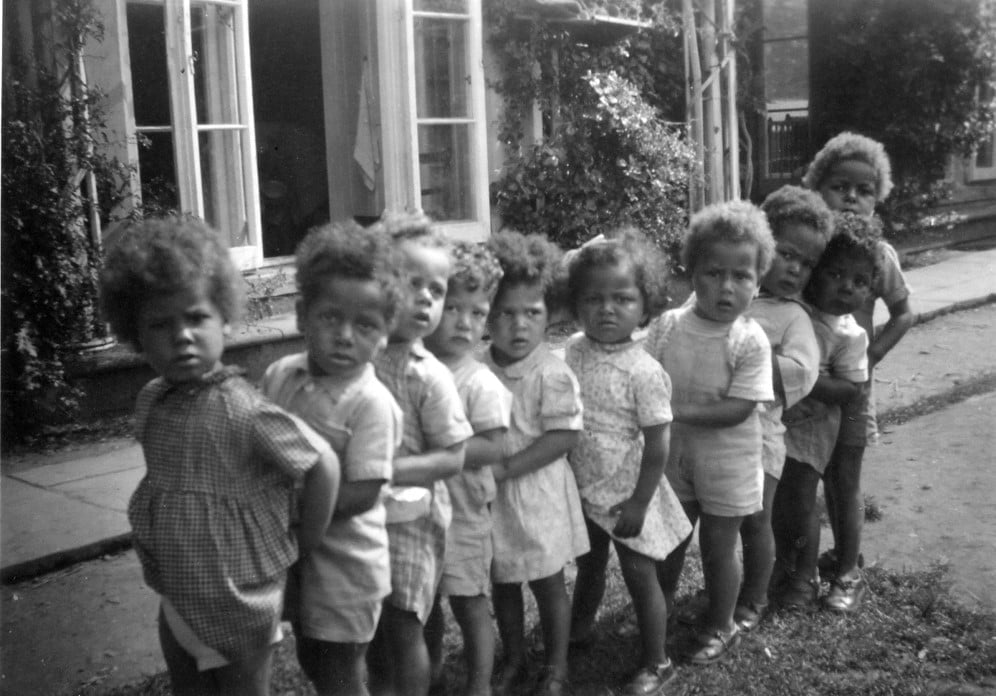
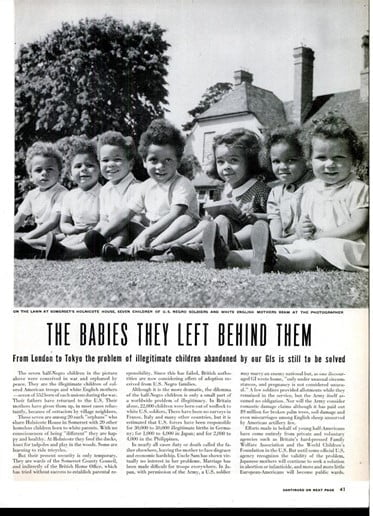
In early 1947, members of the public were invited to inspect Holnicote House and, supposedly unknown to the authorities, a press photographer took photographs, leading to publicity in the US Newsweek and Life and numerous enquiries about possible adoption. The children were also pictured in the Sunday Pictorial in Britain. Despite all this, very few of the children were adopted.
The Children’s Sub-Committee minutes included those of the Adoption Sub-Committee for January 1949 to March 1957. Adoption was at an all-time high in Britain after the war, peaking in 1946 at 21,000. However, few of the mixed-race children at Holnicote House were adopted and in Britain generally, there was a reluctance to encourage the adoption of mixed-race children who were shockingly deemed ‘too hard to place’.
Somerset Council rejected hundreds of adoption applications for ‘brown babies’
The committee notes from January 1949 state that over the previous three years, more than 80 babies aged two weeks to two years had been adopted. This was mainly due to the efforts of Miss Bangham. However, the committee covered the whole of Somerset and so most of these adoptions refer to white babies; in the minutes, potential adoption of ‘coloured’ children was dealt with separately. By January 1950, these minutes note that there had been 269 applications to Somerset from around the country for the adoption of ‘coloured’ children: 82 withdrawn, 187 considered, 174 declined, one temporarily withdrawn, two deferred and 10 accepted as suitable. So of the 269 applications received between May 1949 and January 1950, only 10 were accepted as suitable. This is not to say, however, that those suitable then went on to be approved to adopt.

The minutes do not explain why so many applicants withdrew and why so many were declined. Glimpses of decisions suggest personal biases and assumptions within the Committee. For example, one Children’s Officer did not recommend that a child joined his putative father in the States due to the boy’s ‘light colouring’. In May 1949, the Somerset Adoption Sub-Committee minutes also mention what they refer to as six ‘Special Applications for coloured children’, all of whom were refused. One was from a white woman from Dorking, Surrey. She was married to a Jamaican who had served in the RAF during the war and, with a mixed-race child of her own, she had recently taken out a lease on a mansion to house some of the ‘brown babies’ of England. She offered to take some of the Holnicote House children but was turned down for no apparent reason. It is also possible that some of the potential applicants may have been persuaded to withdraw, given accounts about the discouragement of transracial adoption.
The minutes also confirm what Lucy previously knew regarding three school headteachers who offered places to the children. One of these was Kathleen Tacchi Morris, a dancer from South Africa who ran a progressive, international school in North Curry, Somerset. She offered to educate twelve of Somerset’s ‘brown babies’, asking only for the cost of their keep. A wide-ranging education would be offered free of charge, including music, horse-riding, languages and the opportunity to travel abroad. The council turned her application down, again with no explanation. She did not give up and a year later offered to foster one of the children but, like most of the other people who applied to care for the children, this too was dismissed.
Leaving Holnicote House
So what happened to all the children who had to leave Holnicote House when they turned five, or in 1951 when the house was taken back by its owners, the National Trust? In January 1957, the adoption sub-committee reported on a number of the mixed-race children in their residential children's homes, including some of those who had been at Holnicote House for their first few years. The racist language used to describe the physical and personality characteristics of the children is shocking, as is the number of moves these children endured. One child moved to eight different homes after leaving Holnicote House but was dismissively referred to as ‘demanding of attention’. The instability in the children’s lives seems rarely to have been taken into account when commenting on their behaviour.
One unexpected finding was examples of potential parents’ persistence in attempting to adopt. One case described in the minutes involved a girl who was at Holnicote House. In July 1949, a woman in the US was determined to adopt her. The adoption was continually blocked but finally happened over four years later, the girl now eight and a half. Her adoptive parent simply carried on requesting to adopt her despite all the barriers put her way. Similar persistence was shown by a Reverend and his wife in Jersey who sought over several years and with the help of solicitors to provide a home to two children.
The impact of the visit
One immediate outcome of the visit was the opportunity to clarify the status of the Holnicote House photograph collection.
When Chamion checked the archive catalogue in July 2023, the photographs – featuring the children taking part in everyday activities, playing and participating in nativity plays – appeared with titles and were listed as open access. In the lead up to the 2024 visit, however, Lucy and Chamion found the photographs had since been restricted, and asked the archive team about the change.
The archivist investigated and discovered that during recent digital preservation work, access restrictions from the paper versions (which contain children’s names) had mistakenly been applied to the digital photographs as well. After reviewing the images, the archivist confirmed that the digital photos do not contain identifying names, meaning they did not need to be restricted.
As a result, the digital photographs have now been returned to open access and can be viewed in person at Somerset Archives. Copies of some of these photos had previously been donated to The Mixed Museum by people who took part in Lucy’s research and can be viewed in our digital exhibition.
For many families, these photographs are the only surviving images of children who lived at Holnicote House. Ensuring they remain accessible not only supports historical research but restores visibility and dignity to people whose early lives were shaped by institutional care.
Looking ahead
The visit to Taunton marks another small but meaningful step in uncovering and preserving the histories of Britain’s ‘brown babies’. Some of the findings were incorporated into a joint paper Lucy and Chamion gave in May 2025 at the international conference 'Infants and Institutions: Representations and Memories of Residential Homes in Twentieth-Century Europe', held at the Foundling Museum. TMM also plans to incorporate further details from the visit into the stories we display on our platforms as part of our commitment to working with Lucy and the ‘brown babies’ community to share their history.
A huge thank you to AIM for enabling The Mixed Museum to take part in the visit, and to the staff at Somerset Archives for their thoughtful and collaborative approach in helping broaden knowledge of this important piece of British history.
Learn more
Visit TMM’s ‘brown babies of WW2’ exhibition, curated with Professor Lucy Bland
Read Bec Matthews' account of meeting her Somerset mother’s African American relatives
Consult the Somerset Archives catalogue to find the publicly accessible material relating to Holnicote House